


Financial markets have quickly pivoted from election outcomes to focus on upcoming policy changes, monetary decisions, and economic fundamentals.
The post-election period saw significant gains across major indices, with small-cap stocks experiencing particularly strong performance and cryptocurrency reaching new heights. While these market movements appear favorable, maintaining investment discipline and a long-term focus remains essential for successful portfolio management.
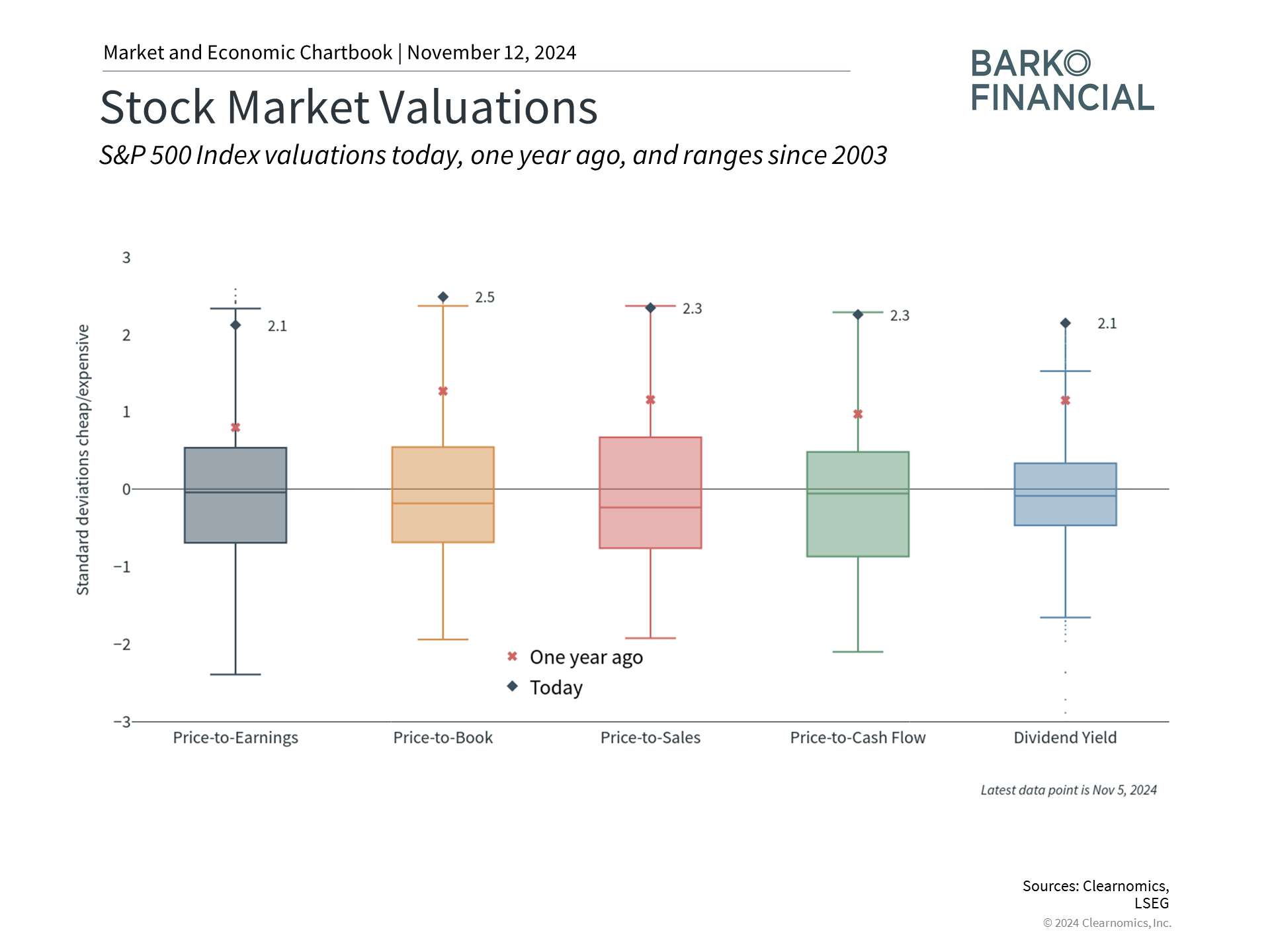
Current market metrics exceed long-term norms
 |
The economic landscape shows considerable strength, with inflation moderating toward the 2% target following pandemic-era supply disruptions and stimulus measures. The Federal Reserve's transition to rate cuts further supports economic momentum.
However, the sustained market rally since late 2022 has pushed asset valuations considerably above historical averages. The S&P 500's price-to-earnings ratio is approaching levels not seen since the dot-com era, suggesting potentially reduced investment opportunities.
Market history demonstrates cycles of investor sentiment swinging between extremes. The 2016-2020 period illustrates this pattern, featuring strong gains in 2017, followed by volatility in 2018, recovery in 2019, and pandemic-related turbulence in 2020. These patterns remind us that markets rarely advance without interruption, regardless of prevailing optimism.
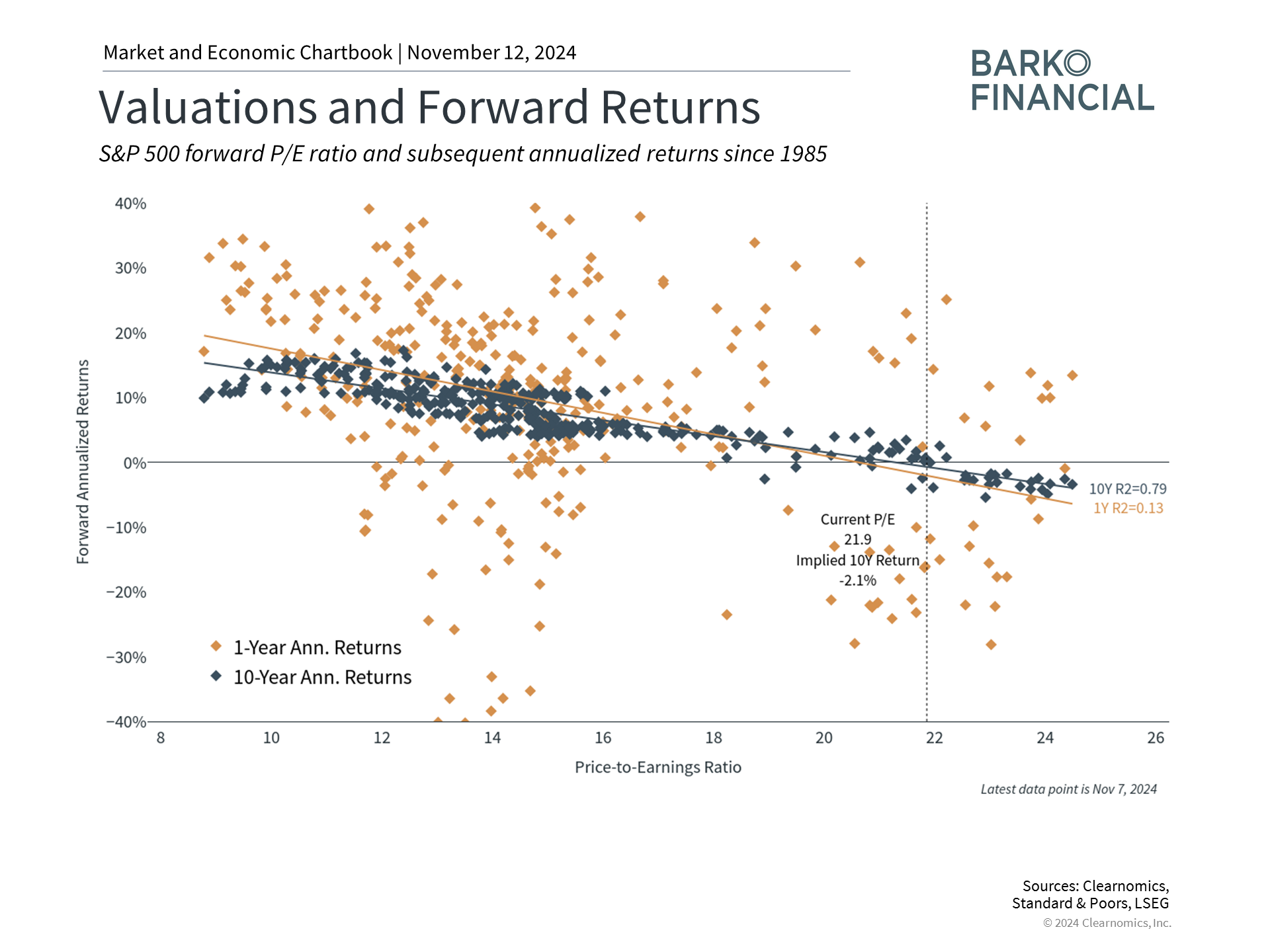
Valuations serve as a reliable compass for investors navigating uncertainty. Long-term performance correlates strongly with whether assets are fairly priced relative to fundamental measures like earnings. While valuations don't predict short-term movements, they help establish realistic long-term return expectations.
Market valuations suggest moderated return potential ahead
 |
Current market enthusiasm reflects anticipated policy changes, including potential tax reforms, trade policies, and infrastructure spending. Similar market dynamics emerged after the 2016 election, driven by expectations of pro-growth initiatives.
Benjamin Graham's observation that markets function as "voting machines" short-term but "weighing machines" long-term remains particularly relevant. This principle applies especially to sectors prone to significant valuation swings, such as technology and digital assets.
Historical data indicates that elevated valuations often precede periods of reduced or negative returns, particularly when occurring late in economic cycles. While optimism suggests this time could be different, rapidly advancing markets may simply be borrowing from future returns.
Diverse asset classes demonstrate positive performance trends
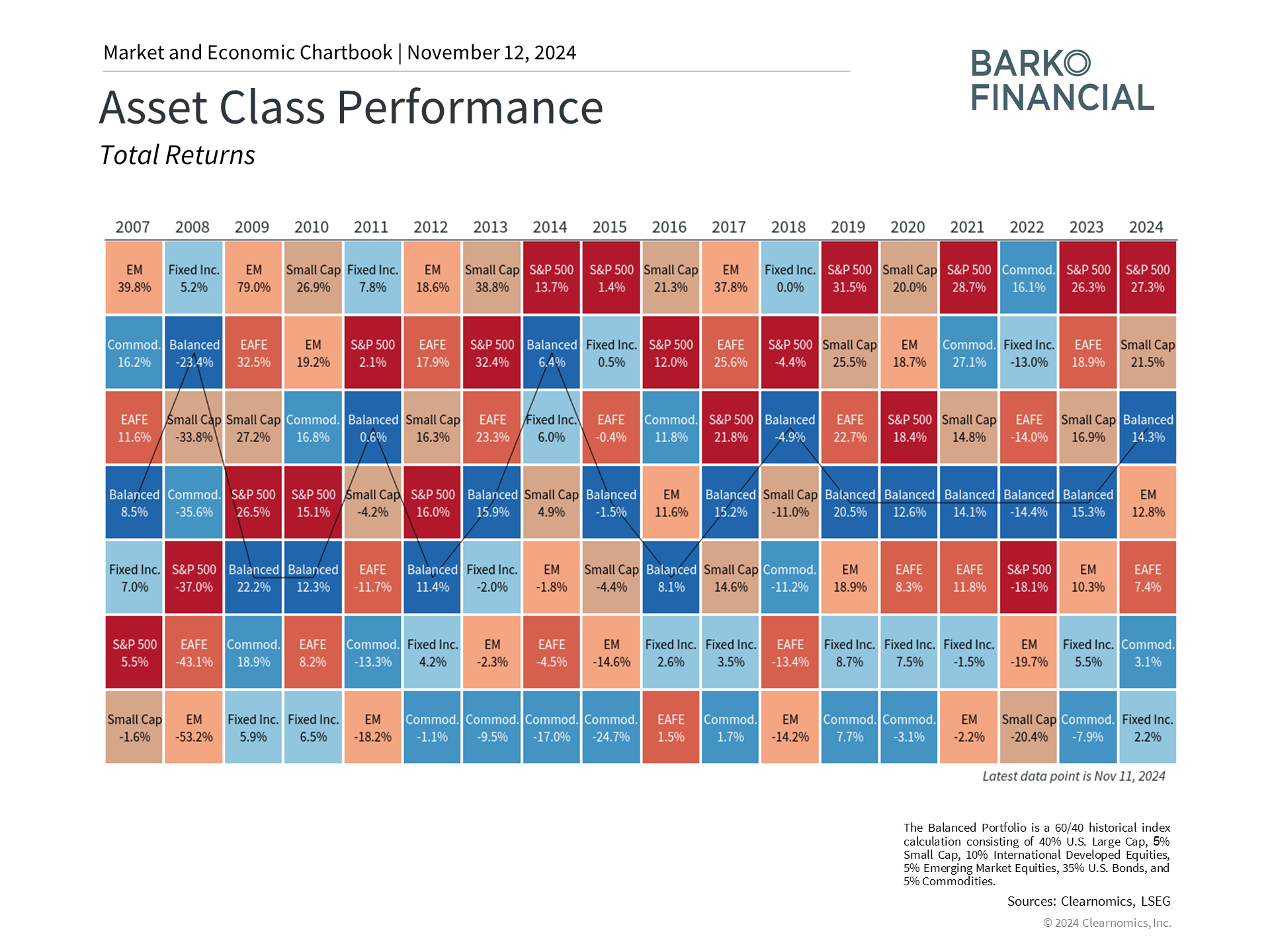 |
Rather than avoiding equities entirely, high valuations suggest implementing careful portfolio construction with robust risk management and diversification strategies. Multiple asset classes have shown positive performance this year alongside U.S. stocks.
Global markets present compelling valuation opportunities compared to domestic equities. Fixed income, despite recent challenges from rising rates, continues to offer portfolio stability and income generation.
Underlying economic indicators remain encouraging, with steady corporate earnings growth and robust GDP figures. The Federal Reserve's recent 25 basis point rate reduction to 4.5-4.75% reflects confidence in economic stability.
The Fed's communications acknowledge shifting labor market conditions while maintaining historically low unemployment levels. Their balanced assessment highlights both economic progress and ongoing monitoring needs.
During recent communications, the Fed Chair emphasized maintaining equilibrium between progress and vigilance - an approach that should mirror portfolio management strategies.
The bottom line? Long-term investment success depends more on fundamental economic trends than short-term market fluctuations. History shows the importance of building portfolios that can capture upside while maintaining protection against uncertainty.