


Following extensive congressional negotiations, President Trump signed comprehensive tax and spending legislation into law on July 4. This sweeping budget measure encompasses numerous provisions, including permanent extension of Tax Cuts and Jobs Act components, increased state and local tax deduction limits, continued estate tax exemptions, and additional measures. The legislation attempts to balance these benefits through targeted spending reductions, particularly in Medicaid programs.
This legislation holds significance because, although trade policy has dominated recent headlines, Washington's tax and spending decisions have created mounting uncertainty over many years. Despite political divisions regarding the budget's direction, it eliminates the threat of a "tax cliff" - a scenario where expiring provisions could have triggered substantial tax policy changes at year-end.
For individuals, taxation directly influences numerous financial planning considerations, with specific bill provisions creating immediate consequences for household budgets. From an economic standpoint, many investors remain concerned about government expenditure levels, expanding national debt, and related factors that have influenced markets over recent decades.
Therefore, this recently enacted budget can be examined from multiple perspectives. What should investors understand regarding their personal financial strategies and the implications for markets moving forward?
Tax Cuts and Jobs Act provisions become permanent fixtures
 |
The administration's "One Big Beautiful Bill" permanently establishes and broadens several critical Tax Cuts and Jobs Act (TCJA) elements from 2017 that faced expiration. Additionally, it introduces new taxpayer benefits that are only partially balanced by spending reductions elsewhere. Several major household-affecting provisions include:
- TCJA tax rates and brackets receive permanent status. These were originally scheduled to sunset after 2025.
- Standard deduction amounts rise to $15,750 for individual filers and $31,500 for married couples filing jointly in 2025.
- Qualifying seniors receive an additional $6,000 deduction (known as a "senior bonus") that phases out for gross incomes above $75,000. This provision expires in 2028.
- Alternative minimum tax exemption becomes permanent. Phaseout thresholds also increase to $500,000 for individual filers, with future inflation indexing.
- Child tax credit expands from $2,000 to $2,200 per child, with inflation adjustments to preserve purchasing power over time.
- State and local tax (SALT) deduction limit rises to $40,000 from the previous $10,000 cap, with 1% annual increases through 2029. The limit returns to $10,000 in 2030.
- Tip income deduction up to $25,000 annually for workers earning under $150,000, effective through 2028.
- Various green energy tax credits face elimination, including electric vehicle and residential energy efficiency incentives.
- Federal debt ceiling increases by $5 trillion. This prevents congressional debt limit debates for an extended period, reducing political uncertainty.
- Business provisions expand tax incentives aimed at promoting domestic investment and employment growth.
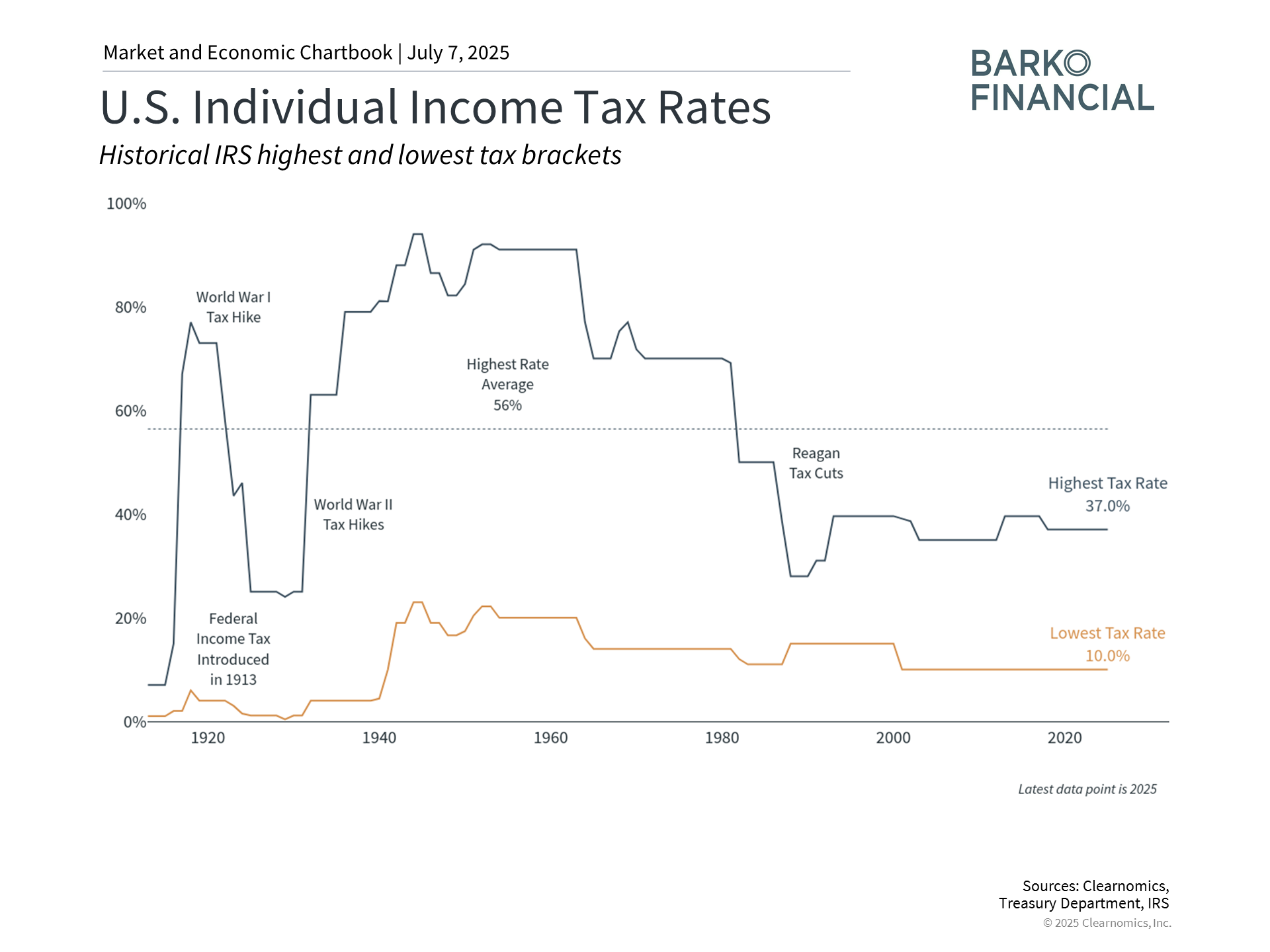
These modifications and others preserve the relatively favorable tax climate that has defined recent decades. The accompanying chart demonstrates that current rates remain significantly below 20th century peaks, when top marginal rates exceeded 70% and occasionally surpassed 90% during wartime.
Mounting fiscal deficit concerns
 |
Tax policy and government deficits represent interconnected issues. Tax reductions decrease government revenues, requiring compensation through either reduced spending or increased borrowing. Nevertheless, most government expenditures support entitlement and defense programs that prove politically challenging to modify. Treasury Department data shows that in 2025, Social Security accounts for 21% of government spending, Medicare represents 14%, National Defense comprises 13%, and interest payments on existing debt consume 14%.
Consequently, government borrowing has grown consistently over the past century and will likely continue this trajectory. The Congressional Budget Office, a nonpartisan congressional support agency, projects this new tax and spending legislation will increase national debt by $3.4 trillion over ten years. This occurs alongside federal debt already exceeding 120% of GDP, totaling $36.2 trillion, or approximately $106,000 per American.
Regrettably, this challenge lacks straightforward solutions, particularly given its contentious political nature. Tax reductions can boost economic growth, potentially offsetting revenue losses through enhanced economic activity. However, Washington maintains a weak record of budget balancing even during strong economic periods. The most recent balanced budgets occurred 25 years ago under Clinton, with the previous instance 56 years earlier during Johnson's presidency.
It's worth noting that income taxation hasn't always existed in America. The contemporary income tax system originated with the 16th Amendment in 1913, initially applying modest rates to relatively few citizens. The system expanded substantially during the Great Depression and World War II, with peak rates reaching 94% by 1944. The post-war era brought various reforms, including President Reagan's 1986 Tax Reform Act that streamlined the code and reduced rates.
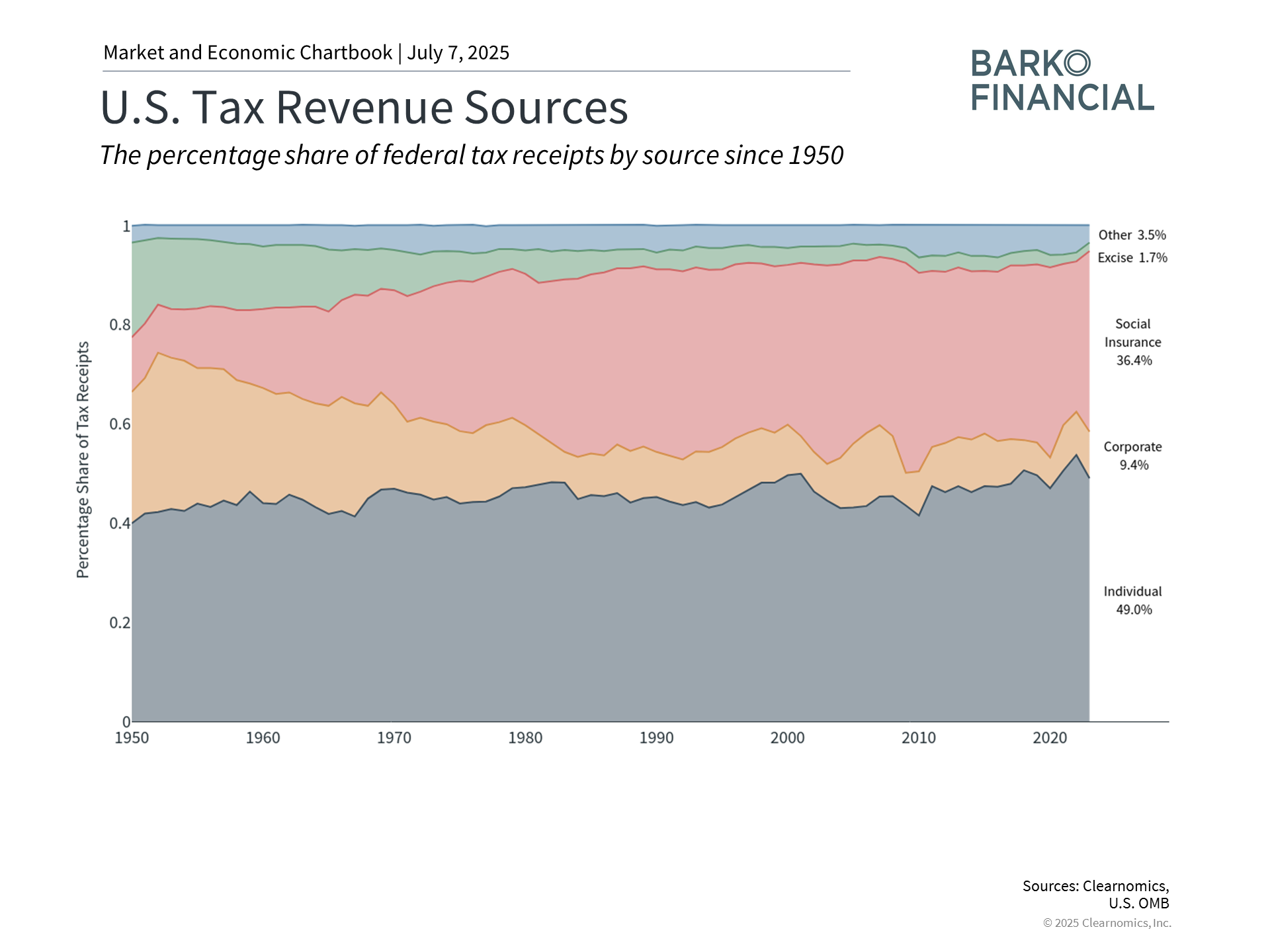
Circumstances have evolved considerably since then. The accompanying chart illustrates that individual income taxes now constitute the primary federal revenue source. Social insurance taxes, or payroll taxes, are deducted from wages to fund Social Security, Medicare, unemployment insurance, and related programs. Other revenue sources remain proportionally smaller, including corporate taxes reduced by the TCJA, and excise taxes such as tariffs.
While tax policies can directly impact investor financial plans and portfolios, their macroeconomic effects remain more constrained. Over extended periods, elevated debt levels may influence interest rates and inflation expectations. Although these factors have been relatively high recently, many worst-case scenarios haven't materialized. Long-term investors should maintain diversified portfolios capable of performing across various fiscal and economic conditions, rather than responding solely to policy modifications.
Legislation maintains elevated estate tax exemption thresholds
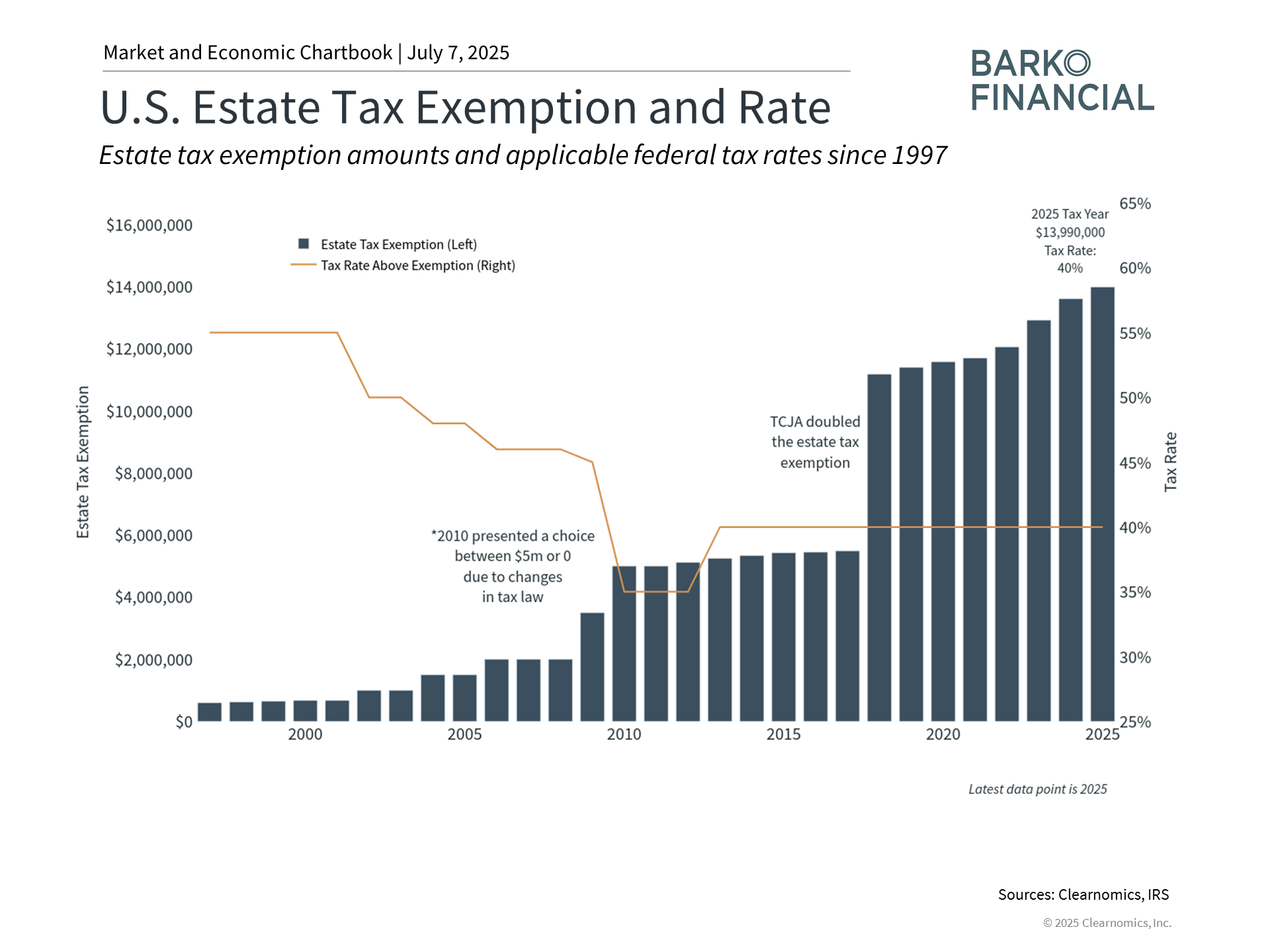 |
Estate tax exemption provisions would have been central to any tax cliff scenario. The TCJA had doubled these limits, which were scheduled to return to previous levels this year. However, the new tax bill's passage makes these higher exemptions permanent, further raising the threshold to $15 million for individuals and $30 million for couples in 2026.
Although estate taxes may appear relevant only to higher net worth families, all households must consider asset transfer strategies to future generations. This requires comprehensive planning that integrates estate considerations, tax efficiency, charitable giving, and long-term family wealth preservation objectives. Additionally, individual states may impose estate taxes with less favorable exemption thresholds than federal levels.
The bottom line? This new spending and tax legislation perpetuates and expands the existing low-tax framework. For investors, well-designed financial plans should incorporate these tax provisions. Regarding increasing deficits and national debt, maintaining a long-term perspective rather than making reactive portfolio adjustments remains crucial.
Click <<HERE>> to read more timely Blog Posts |
The content of this article was provided by Clearnomics and is used with permission. Copyright (c) 2025 Clearnomics, Inc. All rights reserved. The information contained herein has been obtained from sources believed to be reliable, but is not necessarily complete and its accuracy cannot be guaranteed. No representation or warranty, express or implied, is made as to the fairness, accuracy, completeness, or correctness of the information and opinions contained herein. The views and the other information provided are subject to change without notice. The opinions expressed do not necessarily reflect those of StoneX Securities, Inc. This material is for informational purposes only and does not constitute investment advice. Please consult with a financial professional to discuss your individual situation. |