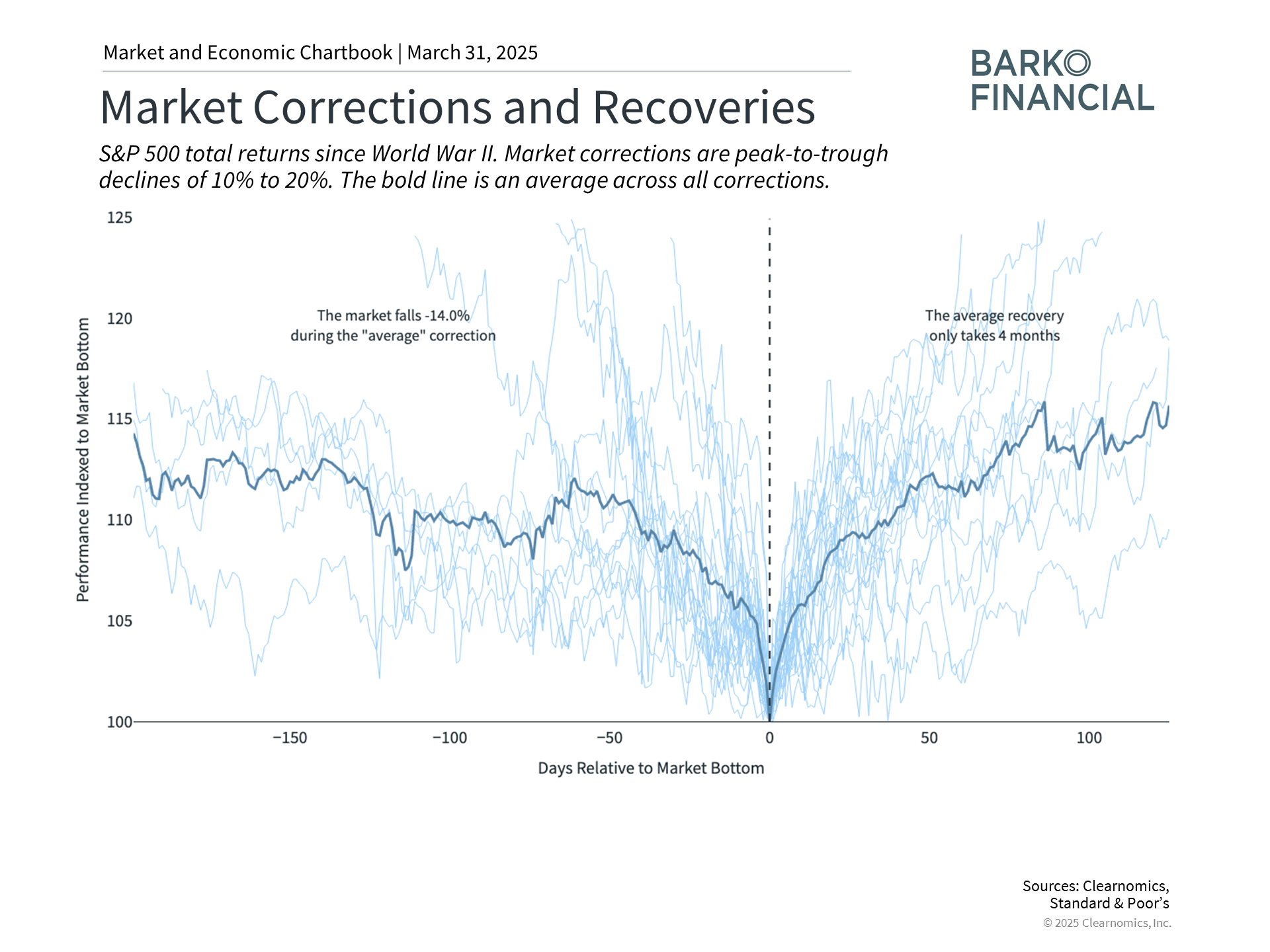
Recent market turbulence driven by trade policy concerns has pushed major indices toward correction territory, leaving many investors wondering about market stability. The technology sector has been particularly affected by the ongoing uncertainty surrounding tariff discussions. During such periods of market stress, it's crucial for investors to maintain a long-term perspective and understand historical patterns. Just as nature follows predictable cycles, financial markets have historically moved through periods of expansion and contraction. While market downturns can feel persistent and uncomfortable, like a long winter, they have typically given way to periods of growth and recovery. Though current trade-related market volatility presents unique challenges, past patterns suggest that markets tend to find their footing once uncertainty diminishes. History shows market corrections are a regular occurrence with eventual recoveries
Currently, the S&P 500 is approaching correction levels, traditionally defined as a 10% decline from recent highs, while the Nasdaq has been in correction territory for several weeks.1 The market has experienced significant daily swings recently, with major indices often moving one to two percentage points in a single session due to economic uncertainty. A common market observation suggests that prices tend to rise gradually but fall sharply. This pattern reflects how bull markets typically develop slowly through steady gains, while corrections often occur rapidly in response to unexpected events, as we've seen this year. However, it's noteworthy that even after corrections, market levels tend to remain above previous cycle peaks. This pattern resembles climbing several flights of stairs before descending a floor or two. This context is particularly relevant now, as the current S&P 500 correction is measured against February's record high. From a broader perspective, the market has only retreated to levels seen last September, highlighting the importance of maintaining a longer-term view. Looking at historical data since World War II, market corrections have averaged 14.3% in magnitude and occur regularly. Despite these periodic declines, markets have typically recovered within months, often rebounding when sentiment is at its lowest. Recent examples include the recoveries following the pandemic in 2020, the tech-driven bear market of 2022, the banking sector concerns in 2023, and numerous other instances. Market timing strategies often lead to suboptimal results
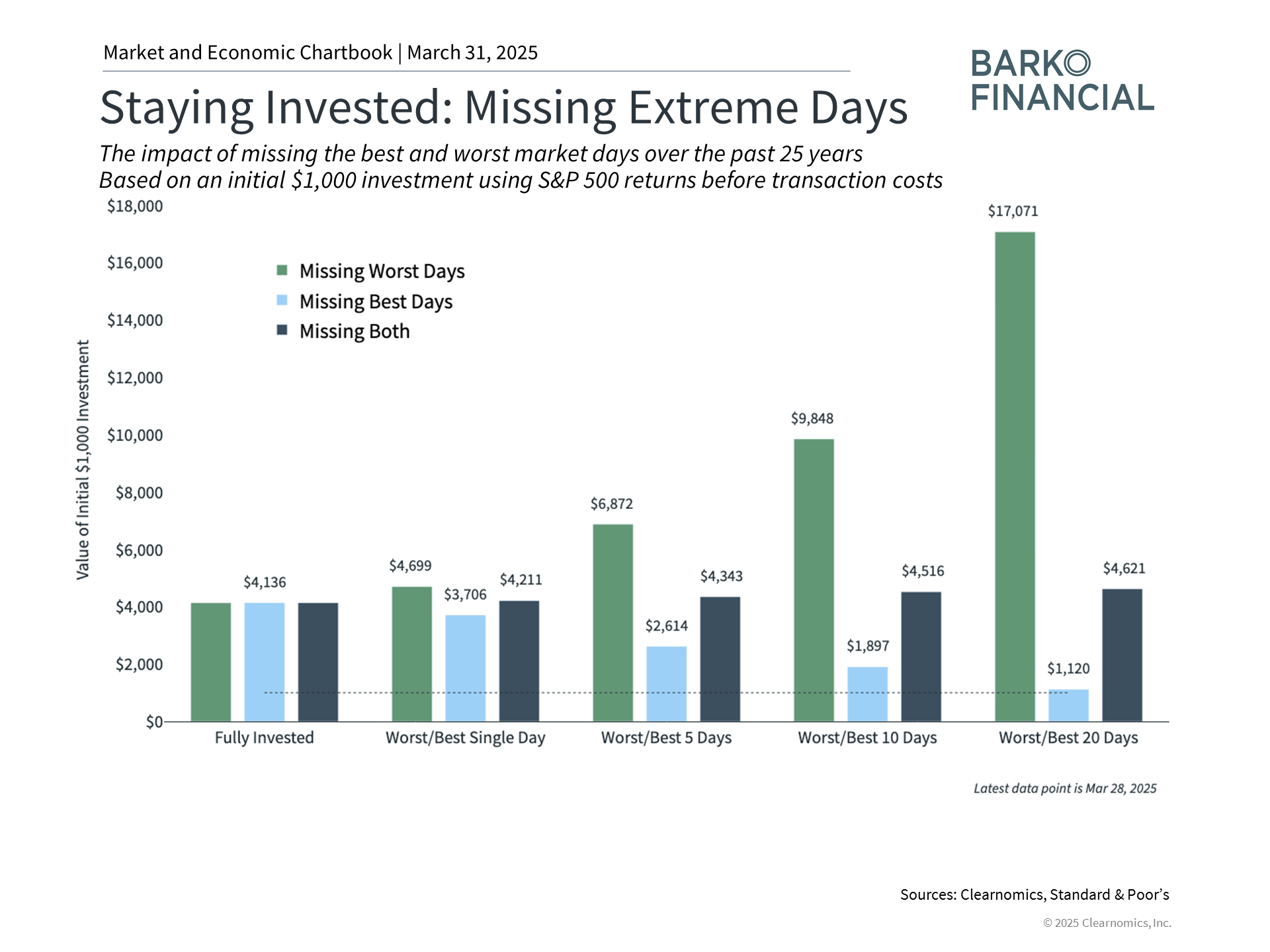
The cyclical nature of markets can tempt investors to attempt timing their entries and exits, particularly during volatile periods. However, this approach frequently proves counterproductive, as investors often miss the initial stages of recovery by waiting on the sidelines. The accompanying chart illustrates the impact of missing both the best and worst market days over a 25-year period, along with the net effect. While avoiding market downturns may seem appealing, accurately predicting market movements consistently is extremely challenging. Even with perfect timing - an unrealistic assumption - the benefits of avoiding both extreme up and down days only marginally outperform a buy-and-hold strategy. This demonstrates why maintaining a long-term investment approach typically yields better results than attempting to time market movements. Trade policy impacts on markets and sector performance
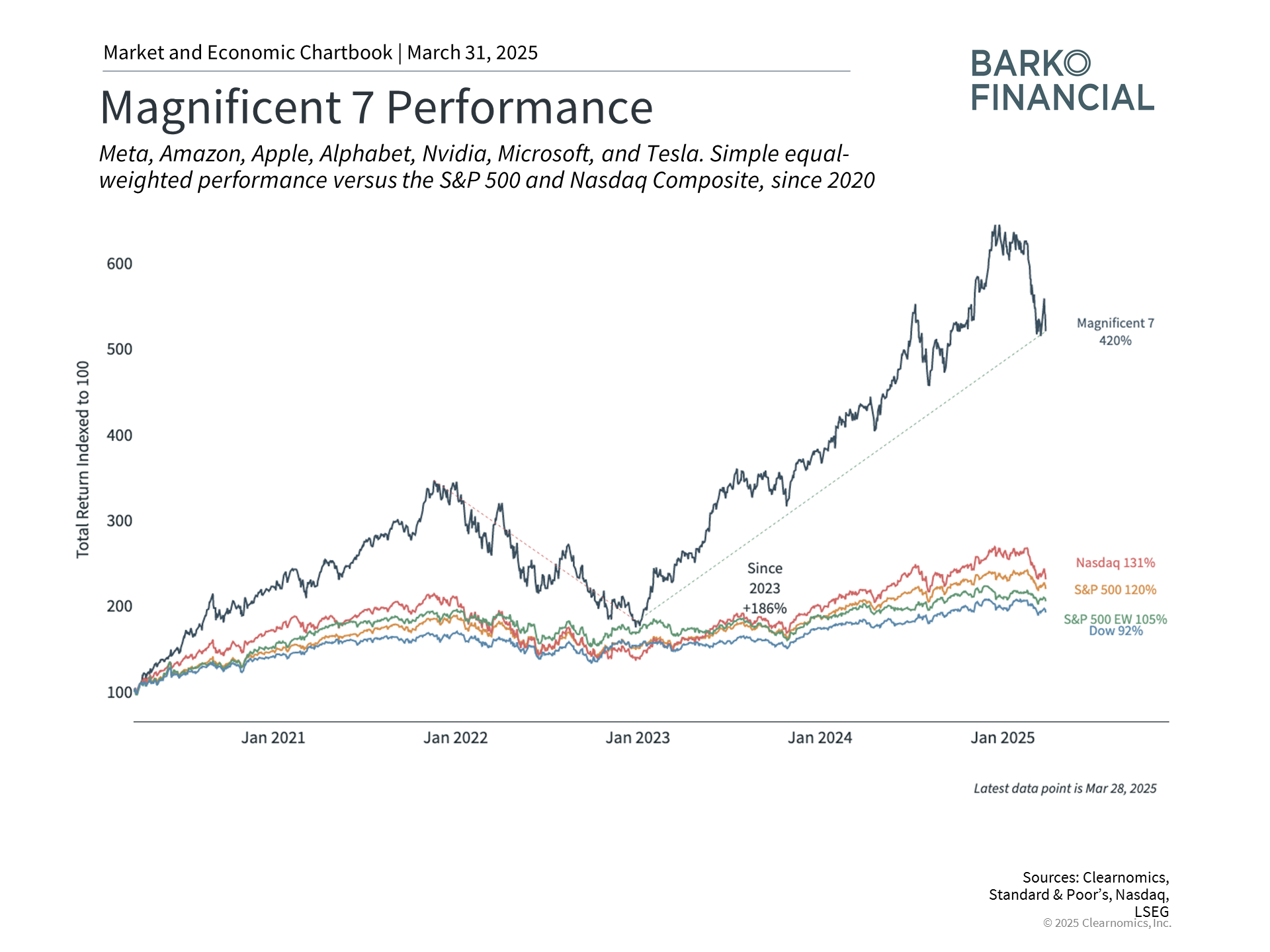
Market participants continue to assess various scenarios regarding the administration's tariff policies, which are often employed as negotiating tools across multiple policy areas, including immigration. Consumer sentiment and inflation expectations have already shown sensitivity to potential price increases. A significant escalation, particularly if met with reciprocal measures from trading partners, could potentially impact global economic growth. The full economic implications of trade policies typically emerge gradually over time. This includes understanding how businesses adapt their supply chains, whether they absorb or pass along additional costs, and how international trading partners respond with potential countermeasures. The technology sector, which previously led market gains, has experienced notable declines during this period, as illustrated in the chart. The Magnificent 7 stocks' recent performance should be viewed within the context of their substantial prior gains. These significant fluctuations exemplify why certain stocks and sectors are considered more volatile than others. Notably, several other sectors have demonstrated resilience, including Energy, Healthcare, Utilities, and Financials. In fact, eight of eleven S&P 500 sectors maintain positive performance over the past year despite recent volatility. This highlights the importance of maintaining diversified portfolios aligned with long-term financial objectives. The bottom line? While tariff-related concerns have increased market volatility, particularly affecting technology stocks, historical evidence suggests that maintaining a long-term focus remains the most effective approach to achieving investment goals. Click <<HERE>> to read more timely Blog Posts 1S&P 500 declined 9.2% between February 19, 2025 and March 28, 2025. The Nasdaq fell 14.1%, between December 16, 2024 and March 28, 2025 | |||