At first glance, the initial six months of 2025 presented considerable obstacles for market participants. Between trade tensions and market volatility, escalating Middle Eastern conflicts, and mounting concerns about national debt levels, investors might perceive financial markets as navigating from one challenge to another. Media coverage frequently delivers a continuous flow of concerning news, potentially amplifying the perception of difficulty beyond reality. Nevertheless, wisdom suggests that crises should not be squandered. Though this concept frequently appears in political discourse, it applies equally to long-term investment strategies and financial planning. Examining situations beyond surface-level reporting often uncovers significant opportunities for market participants. While the first half brought market declines for the S&P 500 and Dow, plus bear market conditions for the Nasdaq, it simultaneously featured one of history's most rapid recoveries. Combined, these conditions favored investors who concentrated on asset allocation strategies and maintained comprehensive viewpoints. Though uncertainty remains uncomfortable, risk and reward represent two facets of the same concept. If maintaining investment discipline and seeing beyond immediate news were simple, universal participation would occur, potentially diminishing future return prospects. These principles remain crucial as we navigate heightened uncertainty entering the year's second half. The following section examines five essential perspectives that can assist investors in managing current markets and positioning portfolios for opportunities, independent of specific upcoming headlines. Market resilience emerges as we enter the second half
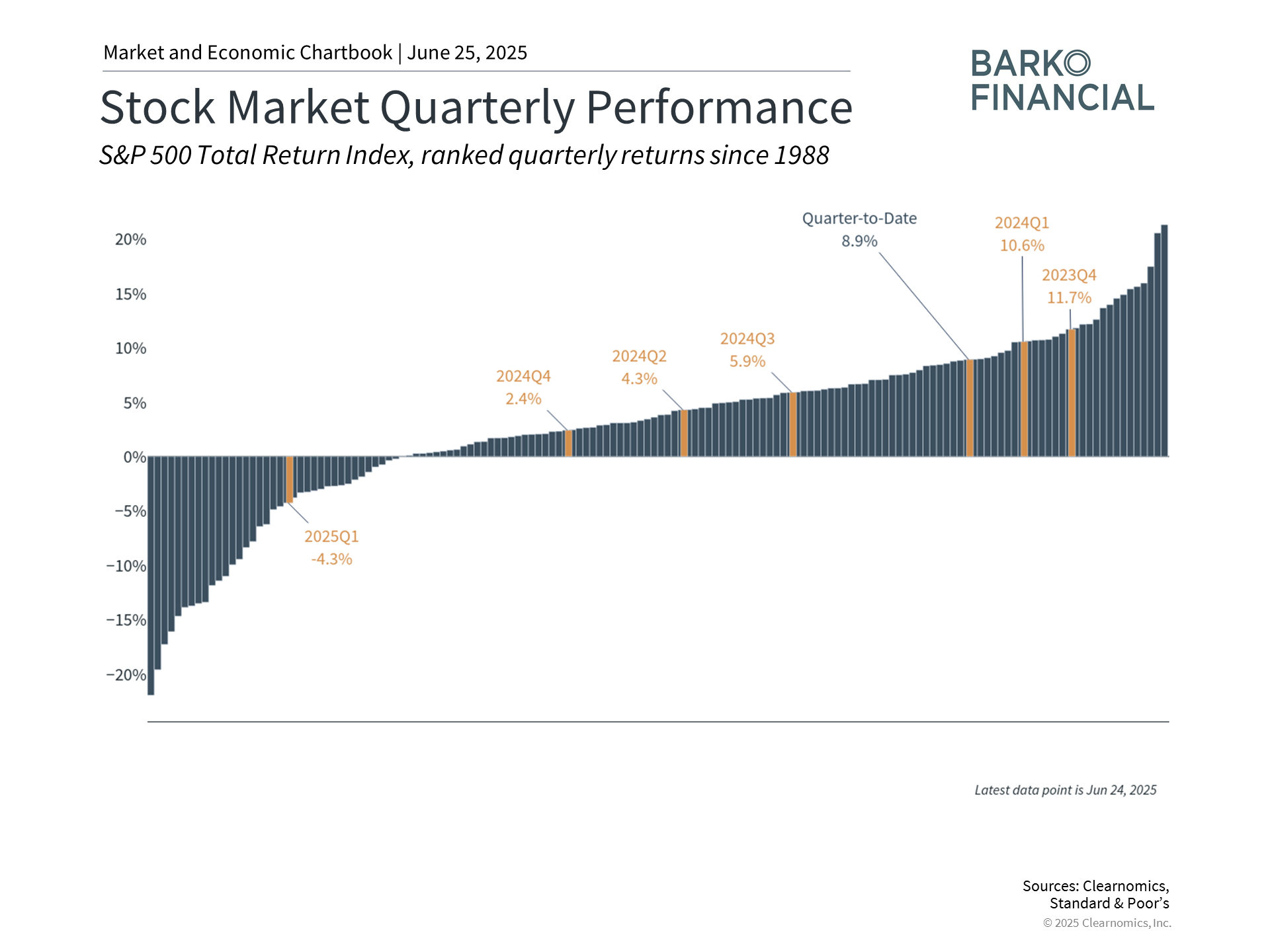
Market participants have grown familiar with volatility over recent years. This year continued that pattern, with many concerned about entering prolonged trade conflicts that could persist for years, potentially triggering global economic contraction. Though tariff concerns persist throughout the economy, recent trade agreements have reduced the probability of worst-case outcomes. The accompanying chart demonstrates markets' significantly improved second-quarter performance compared to the first quarter for this reason. Moving ahead, markets will likely remain sensitive to subsequent trade agreement phases. The 90-day suspensions for most nations conclude in July, while the reported Chinese agreement has not fully materialized. The administration has demonstrated its commitment to securing new agreements, similar to actions in 2018 and 2019. Regardless of specific results, average tariff levels on imported goods have increased substantially this year, potentially affecting consumer inflation and corporate profit margins. Investors should consider these factors during the year's second half. While rapid market recovery never carries guarantees, the essential approach involves focusing on fundamental trends. Markets look forward and demonstrate adaptability to evolving circumstances. Geopolitical concerns currently dominate news coverage
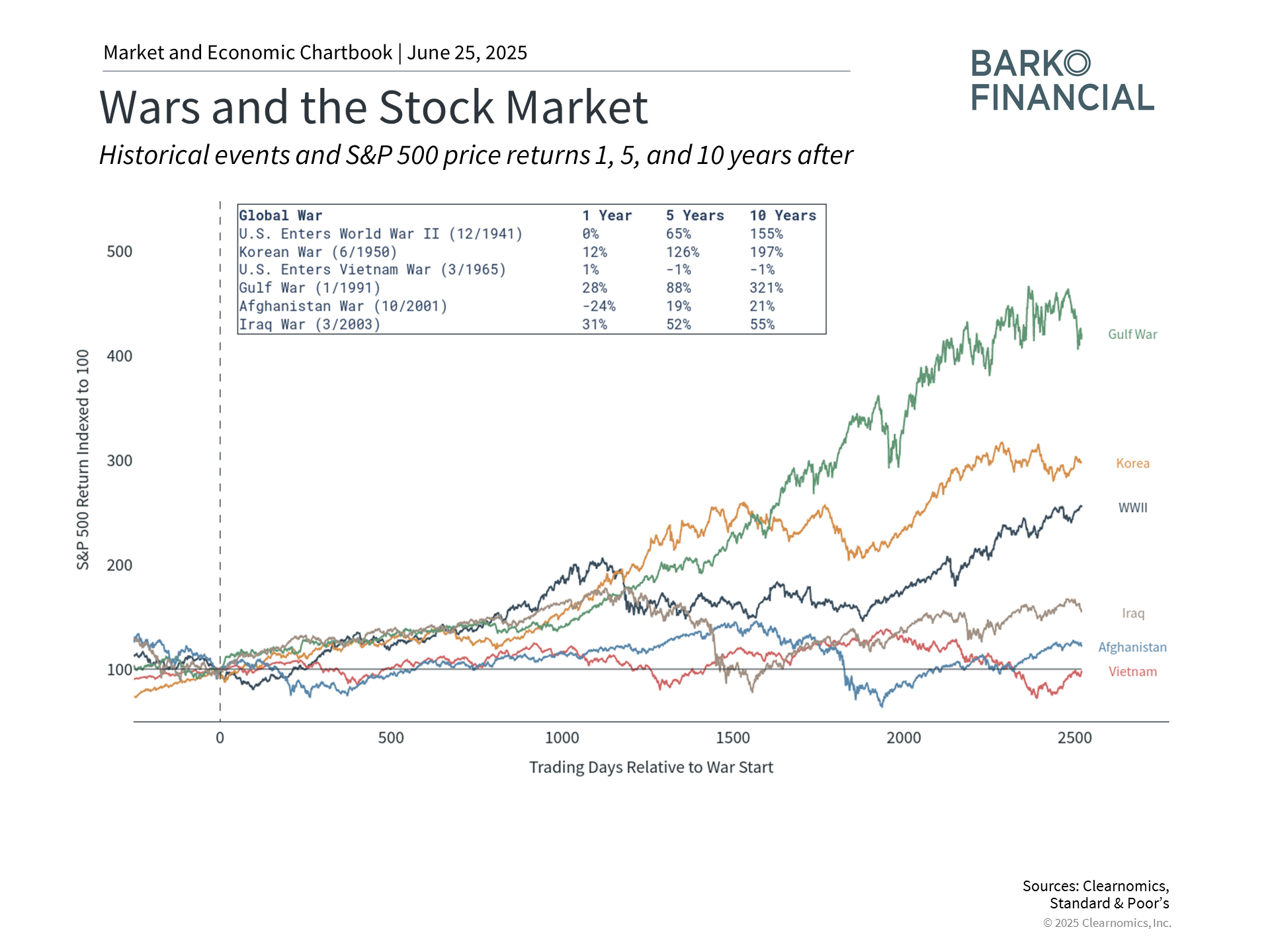
Geopolitical tensions have heightened, especially with the Israel-Iran conflict escalation now involving U.S. military forces. This naturally generates concern among some investors since these developments differ from typical business and economic news. Fortunately, historical analysis provides valuable insights into markets' typical responses to geopolitical events. The accompanying chart demonstrates that markets have typically rebounded from geopolitical disruptions over time, frequently within months of initial disturbances. Even major events like wars showed limited long-term effects on diversified portfolios. This observation doesn't diminish the human and societal impact of conflicts, but serves as a reminder that dramatic portfolio adjustments based on geopolitics rarely prove beneficial. Instead, market and economic trends proved more significant during these historical periods. The Gulf War occurred during the extended 1990s bull market driven by information technology advances. Conversely, the Afghanistan war began following the dot-com collapse and spanned multiple economic cycles. Looking further back, the American economy remained challenged by Great Depression effects when World War II commenced. War efforts stimulated industrial activity and drove markets higher. The Vietnam War, however, coincided with a difficult stagflation period. Current market concerns regarding the Iran conflict focus on oil supply disruptions. The Strait of Hormuz south of Iran represents a crucial waterway transporting over one-fifth of global oil supplies. Any disruption to oil production or critical supply routes could cause oil price increases, fueling inflation. Despite this risk, oil prices have remained within narrow ranges as conflict has escalated. Brent crude prices have only returned to January levels. While the situation continues evolving, maintaining balance when evaluating geopolitical impacts remains important. Economic conditions appear robust
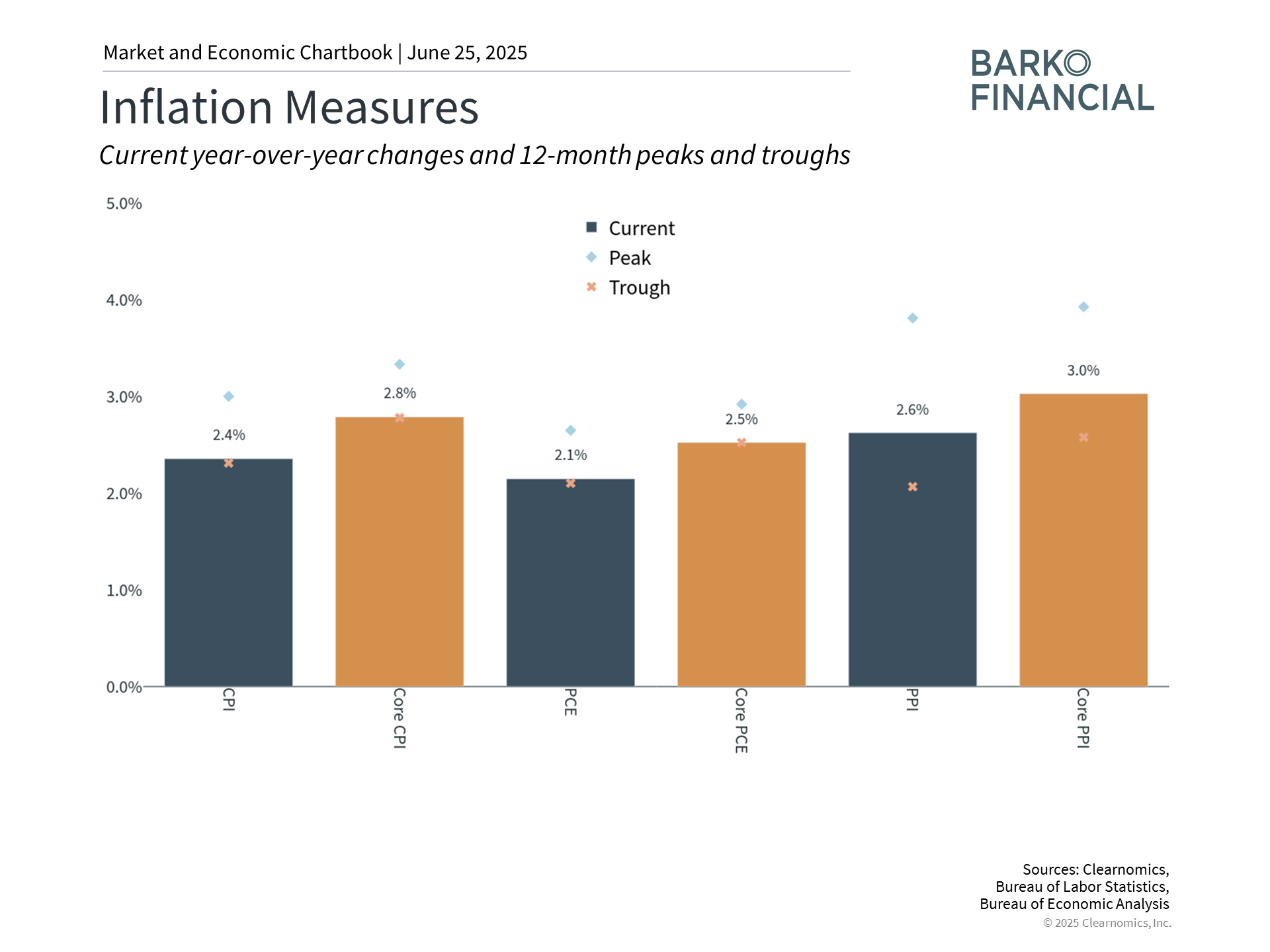
The U.S. economy's resilience represents perhaps the most significant positive development over recent years. What has most surprised investors is labor market strength even as inflation has declined toward more historically typical levels. The accompanying chart indicates most inflation measures remain at or below 3%. The most recent GDP report showed a 0.2% economic contraction during the year's first quarter. However, details reveal this primarily resulted from trade factors as companies accumulated imported goods before potential tariffs. Consumer spending, representing the largest economic growth component, maintained steady growth, supporting overall economic activity. Without trade disruptions, GDP growth would likely have been positive. One concern likely to resurface during the second half involves growing national debt due to ongoing government spending and deficits. This prompted Moody's to downgrade U.S. debt in May, following similar actions from other rating agencies including Standard & Poor's in 2011 and Fitch in 2023. This issue will return to prominence as Congress debates the next budget bill, including Tax Cuts and Jobs Act extension provisions. National debt presents serious long-term challenges for the country and economy, particularly given the apparent absence of long-term solutions. However, avoiding portfolio overreactions remains crucial. Historical evidence shows that making portfolio decisions based on Washington fiscal policy would have been counterproductive. Instead, these periods often create opportunities for investors across stocks and bonds. Asset categories beyond U.S. equities have shown strong performance
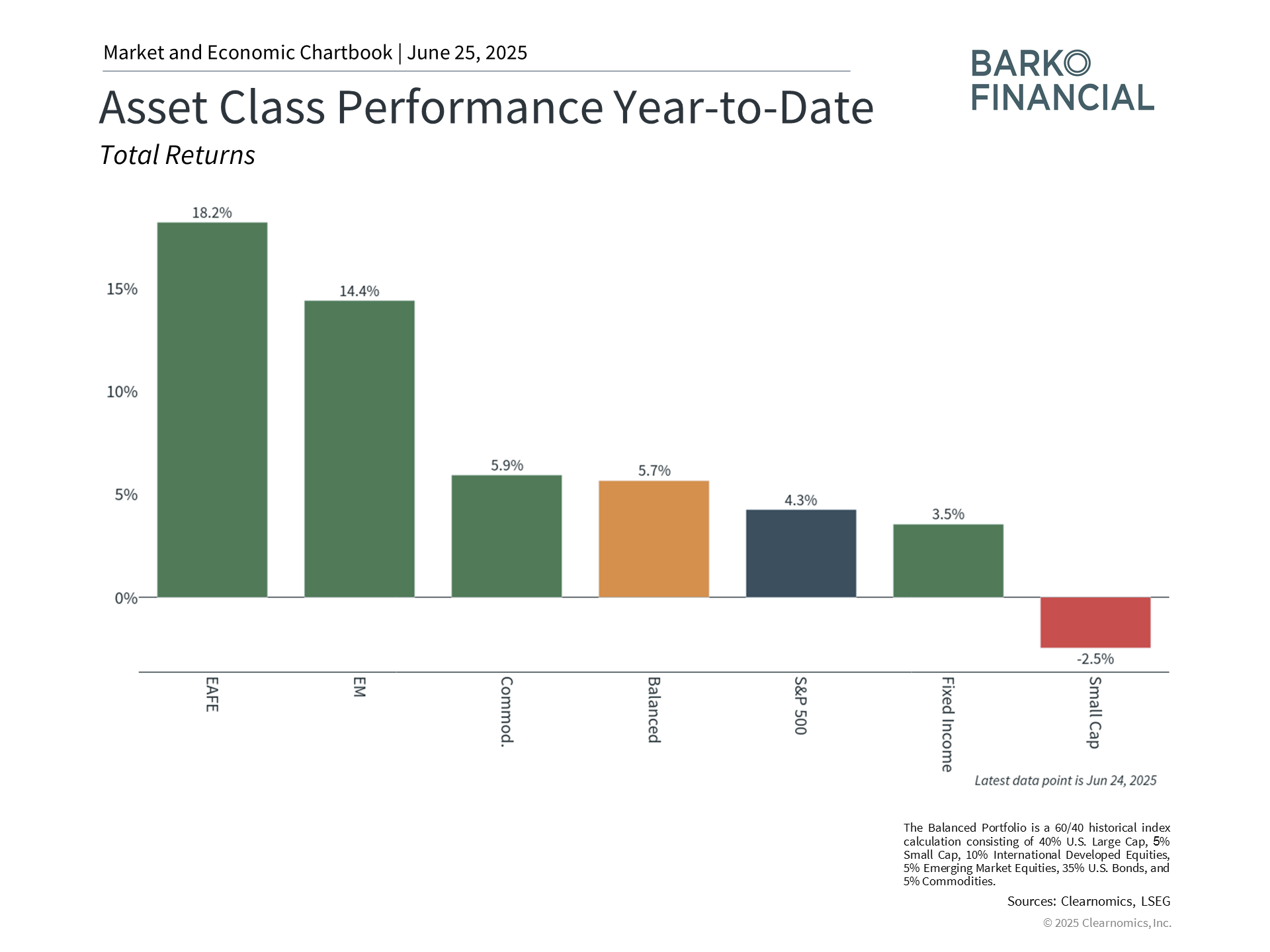
The market rebound's primary challenge is that U.S. stock valuations have again reached expensive levels. However, elevated valuation conditions have generated opportunities in other market areas. International equities, small-cap companies, and value-oriented sectors frequently trade at more attractive multiples, providing potential opportunity sources for patient investors. Bond markets also present compelling prospects, with yields remaining above long-term averages across most fixed income sectors. 2025's most significant developments include strong international stock performance, with developed and emerging markets achieving double-digit gains based on MSCI EAFE and MSCI EM indices. This has been partially driven by U.S. dollar weakness. When the dollar declines, foreign currency-denominated assets become more valuable. This serves as a second-half reminder that market leadership rotates over time. Maintaining exposure to different regions can both enhance portfolio results and potentially reduce risk through diversification. While past performance doesn't guarantee future outcomes, current conditions highlight why investors often benefit from patient, long-term approaches that capture opportunities across global markets. Advantages of maintaining long-term perspectives
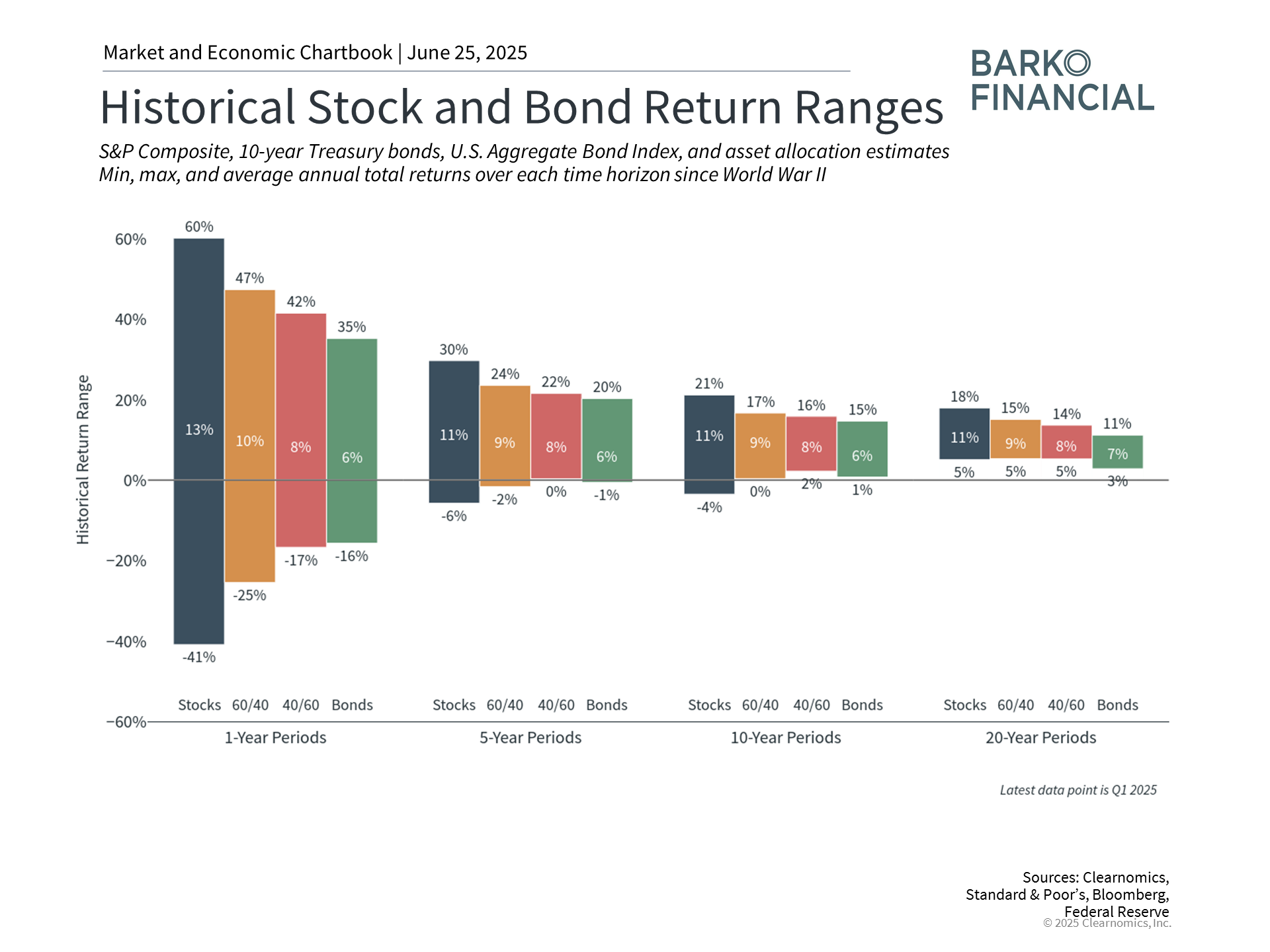
First-half patterns represent challenges investors have encountered throughout history. They demonstrate that extending investment time horizons can improve portfolio results, even during the most difficult market climates. The accompanying chart shows that while annual returns can fluctuate significantly - with stocks ranging from substantial losses to considerable gains in any given year - this volatility has historically diminished over extended periods. Over 10-year and longer horizons, outcome ranges narrow substantially, explaining why stocks and bonds have historically formed the foundation of long-term portfolios. This historical perspective reinforces the importance of maintaining commitment to well-constructed portfolios despite short-term concerns. This will prove even more critical as new developments challenge markets in coming months. The bottom line? The first half of 2025 emphasizes the importance of maintaining long-term focus. Investors who preserve discipline and concentrate on long-term principles are well-positioned to navigate the second half and accomplish their financial objectives. Click <<HERE>> to read more timely Blog Posts | |||||
The content of this article was provided by Clearnomics and is used with permission. Copyright (c) 2025 Clearnomics, Inc. All rights reserved. The information contained herein has been obtained from sources believed to be reliable, but is not necessarily complete and its accuracy cannot be guaranteed. No representation or warranty, express or implied, is made as to the fairness, accuracy, completeness, or correctness of the information and opinions contained herein. The views and the other information provided are subject to change without notice. The opinions expressed do not necessarily reflect those of StoneX Securities, Inc. This material is for informational purposes only and does not constitute investment advice. Please consult with a financial professional to discuss your individual situation. |