



May delivered strong market performance as equities rebounded from earlier losses, with the S&P 500 returning to positive territory for the year. The month unfolded amid evolving trade negotiations, contrasting economic indicators, and heightened focus on America's fiscal position. Although economic data continued demonstrating strength, consumer confidence lagged behind fundamental indicators. Bond yields experienced volatility as investors weighed federal budget concerns and debt sustainability. For those with long-term investment horizons, May demonstrated how markets can navigate uncertainty while adapting to shifting policy landscapes.
Primary Market and Economic Factors1
- The S&P 500 advanced 6.2% during May, marking its strongest monthly performance since 2023, while the Dow Jones Industrial Average climbed 3.9% and the Nasdaq surged 9.6%. For the year, the S&P 500 stands at 0.5% gains, the Dow shows a 0.6% decline, and the Nasdaq remains down 1.0%.
- The Bloomberg U.S. Aggregate Bond index dropped 0.7% in May yet maintains a 2.4% year-to-date advance. The 10-year Treasury yield concluded May at 4.4%.
- Global equities also demonstrated strength with both the MSCI EAFE developed markets index and MSCI EM emerging markets index posting 4.0% gains.
- The U.S. dollar index continued its decline, finishing May at 99.3, approaching three-year lows.
- Bitcoin reached a new peak of $111,092 before closing the month at $104,834.
- Gold achieved a record high of $3,422 before settling at $3,288 monthly close, representing a 24% year-to-date increase.
- The May Consumer Price Index report indicated April consumer prices increased 2.3% year-over-year, the smallest 12-month rise since February 2021.
- April employment data showed 177,000 new jobs created while unemployment held steady at 4.2%.
Market resilience persisted despite emerging challenges
The May recovery highlights the value of maintaining investment discipline during volatile periods. Following April's setbacks, markets showed their capacity to regain ground and achieve positive performance when conditions stabilized. This rapid sentiment reversal reflects a familiar pattern investors have witnessed repeatedly over recent years. However, past performance cannot predict future results, and markets will likely continue monitoring trade developments, fiscal health, and economic indicators in upcoming months.
Credit rating agency downgrades U.S. sovereign debt
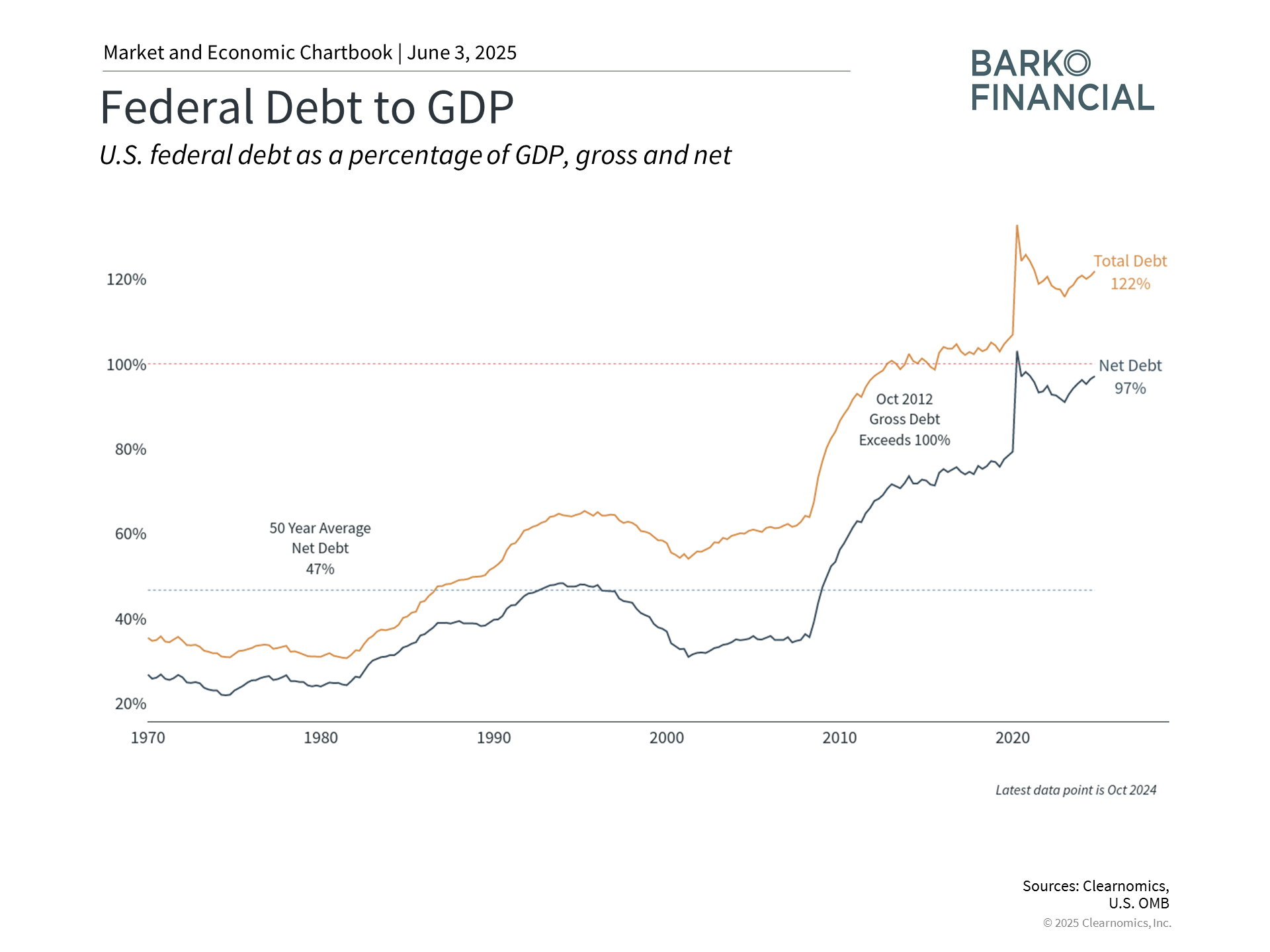 |
Among May's most significant developments was Moody's decision to lower the U.S. credit rating from Aaa to Aa1. This action followed earlier downgrades from Fitch in 2023 and Standard & Poor's in 2011, all citing concerns regarding expanding debt levels and government spending. The chart illustrates how U.S. total debt reached 122% of GDP in 2024, while net debt, excluding intragovernmental holdings, climbed to 97%.
Markets showed minimal reaction to this historic downgrade, largely because the assessment reflected already-known fiscal realities rather than new information. The subdued response also drew from lessons learned during the 2011 Standard & Poor's downgrade, when Treasury securities maintained their status as preferred safe-haven investments.
The timing coincided with House passage of comprehensive tax and spending legislation. The approved measures would extend individual tax provisions from the Tax Cuts and Jobs Act, maintaining the 37% top rate, child tax credits, expanded State and Local Tax deduction limits, and exemptions for tips and overtime compensation. The Penn Wharton Budget Model estimates this legislation could add $2.8 trillion to deficits over ten years.2 The Senate will now consider and potentially modify the proposal.
Although these fiscal challenges demand long-term attention, the U.S. dollar's status as the world's dominant reserve currency ensures continued Treasury demand in the near term.
Diplomatic progress emerges in trade discussions
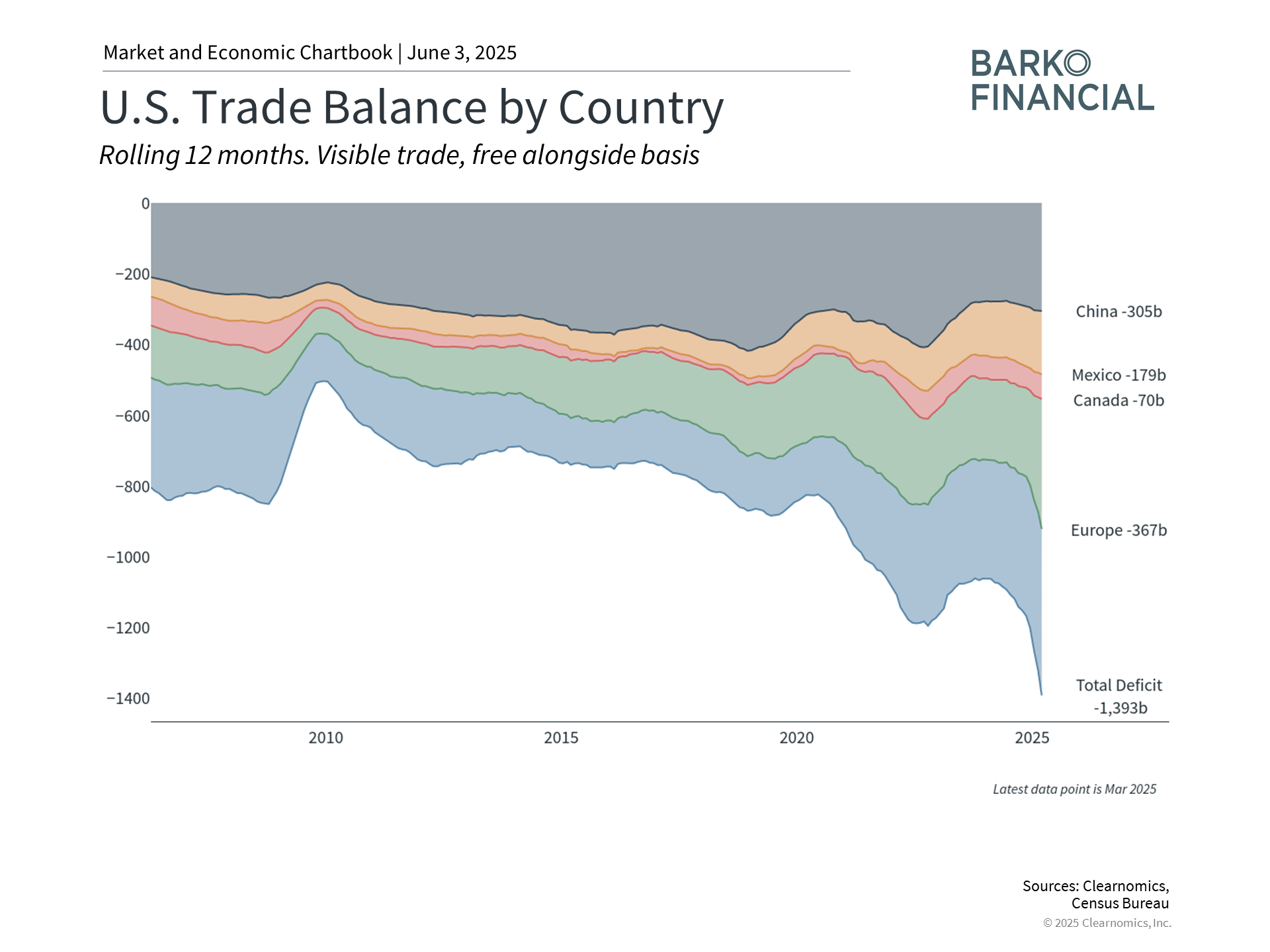 |
May brought meaningful advancement in trade negotiations, reducing concerns about extreme outcomes. The administration secured agreements with both the U.K. and China while maintaining dialogue with other key trading partners. The U.S.-China arrangement established a 90-day window of reduced American tariffs on Chinese imports.
Trade uncertainty persists despite these achievements. Recently, both nations have alleged violations of their trade agreement, and the administration seeks increased tariffs on steel and aluminum products. Simultaneously, European Union negotiations generated optimism when the White House postponed its planned 50% EU tariff following constructive talks. This development suggests diplomatic solutions remain viable even when initial positions appear irreconcilable.
Legal challenges to tariff implementation have also emerged. During May, the U.S. Court of International Trade invalidated numerous recently imposed tariffs, determining they exceeded presidential authority under the International Economic Emergency Powers Act. While a federal appeals court suspended this ruling, maintaining current tariffs temporarily, the legal dispute introduces additional complexity to trade policy.
Trade policy evolution typically occurs over extended periods rather than immediate timeframes. May's recovery reinforces the importance of avoiding overreaction to trade-related news, particularly as extreme scenarios become less probable.
Corporate earnings provide market support
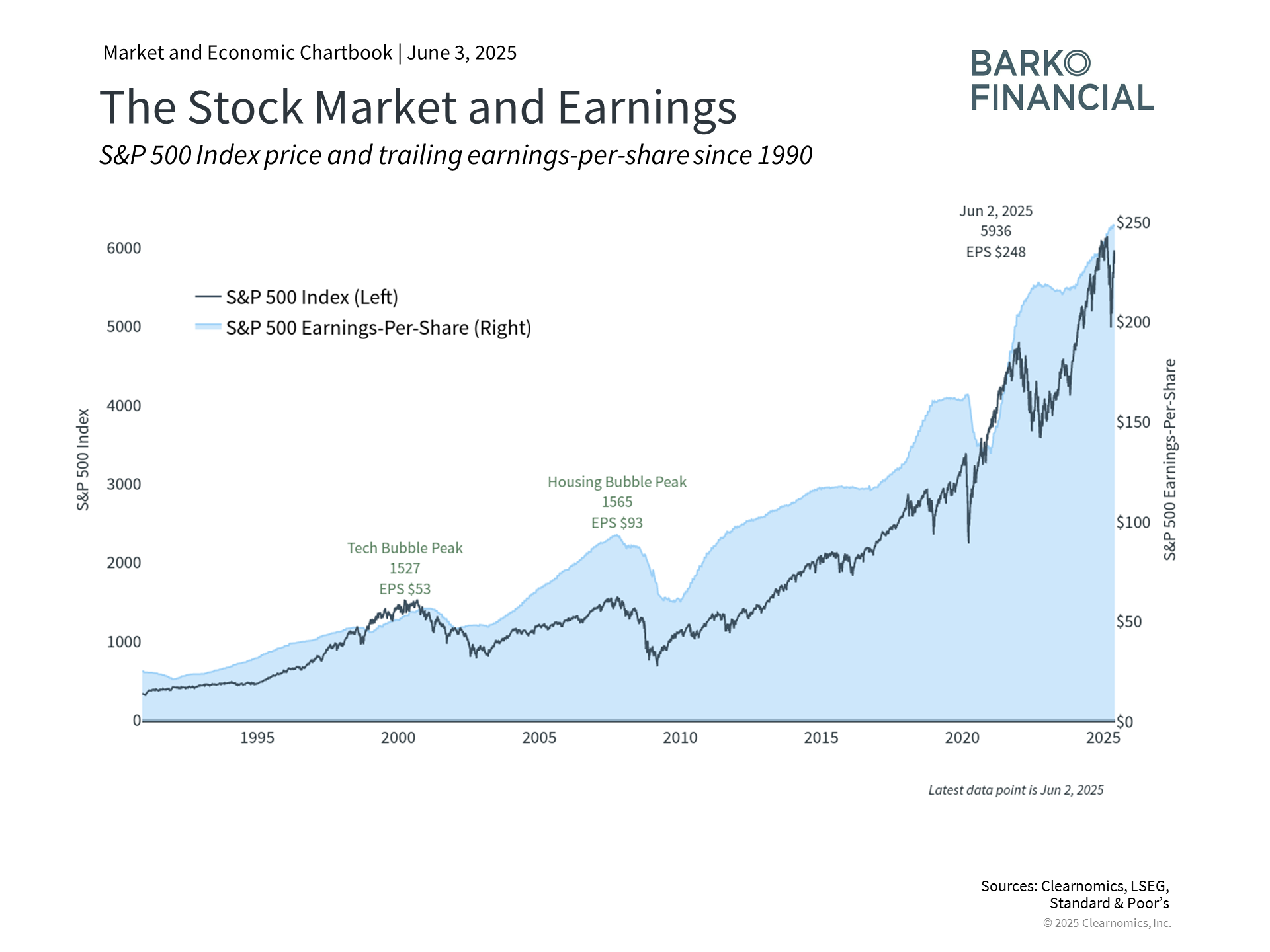 |
First quarter earnings reports offered additional reasons for optimism. S&P 500 companies exceeded earnings per share expectations while 64% delivered positive revenue surprises, per FactSet data.3 This robust earnings performance demonstrated corporate profitability strength, with technology firms showing particular resilience amid trade policy uncertainty.
Consumer sentiment, however, remained subdued throughout the year due to tariff and inflation concerns. Recent sentiment measures began indicating improvement that better aligns with positive earnings and economic fundamentals. The University of Michigan's May survey revealed slightly declining inflation expectations and stabilizing sentiment levels.4 While single-month data requires cautious interpretation, this improvement represents a promising development. Strong economic fundamentals combined with improving sentiment could provide continued market support.
The bottom line? May delivered strong results for investors despite challenges from the U.S. credit downgrade and fiscal concerns. Progress in trade negotiations helped drive market gains, reminding long-term investors to maintain perspective and focus on fundamental trends rather than short-term policy developments.
Click <<HERE>> to read more timely Blog Posts
Sources:
1. Standard & Poor's, Nasdaq, Bloomberg. All month end figures are as of May 30, 2025.
2. https://budgetmodel.wharton.upenn.edu/issues/2025/5/23/house-reconciliation-bill-budget-economic-and-distributional-effects-may-22-2025
3. FactSet Earnings Insight May 30, 2025
4. https://www.cbsnews.com/news/michigan-consumer-sentiment-index-may-2025/