


The recent pullback in technology stocks has sparked discussions about market health and sustainability. While artificial intelligence-driven companies have been key market drivers, their recent underperformance has highlighted issues around market concentration, valuation levels, and potential bubble comparisons. These developments raise important questions about portfolio positioning and risk management.
Market gains are becoming more widespread
 |
Understanding the distinction between tech stock performance and broader market health is crucial for investors. While these innovative companies have demonstrated impressive growth trajectories, their elevated valuations present both possibilities and risks. Historical patterns indicate that market leadership regularly shifts between sectors and styles, suggesting the importance of maintaining diversified market exposure.
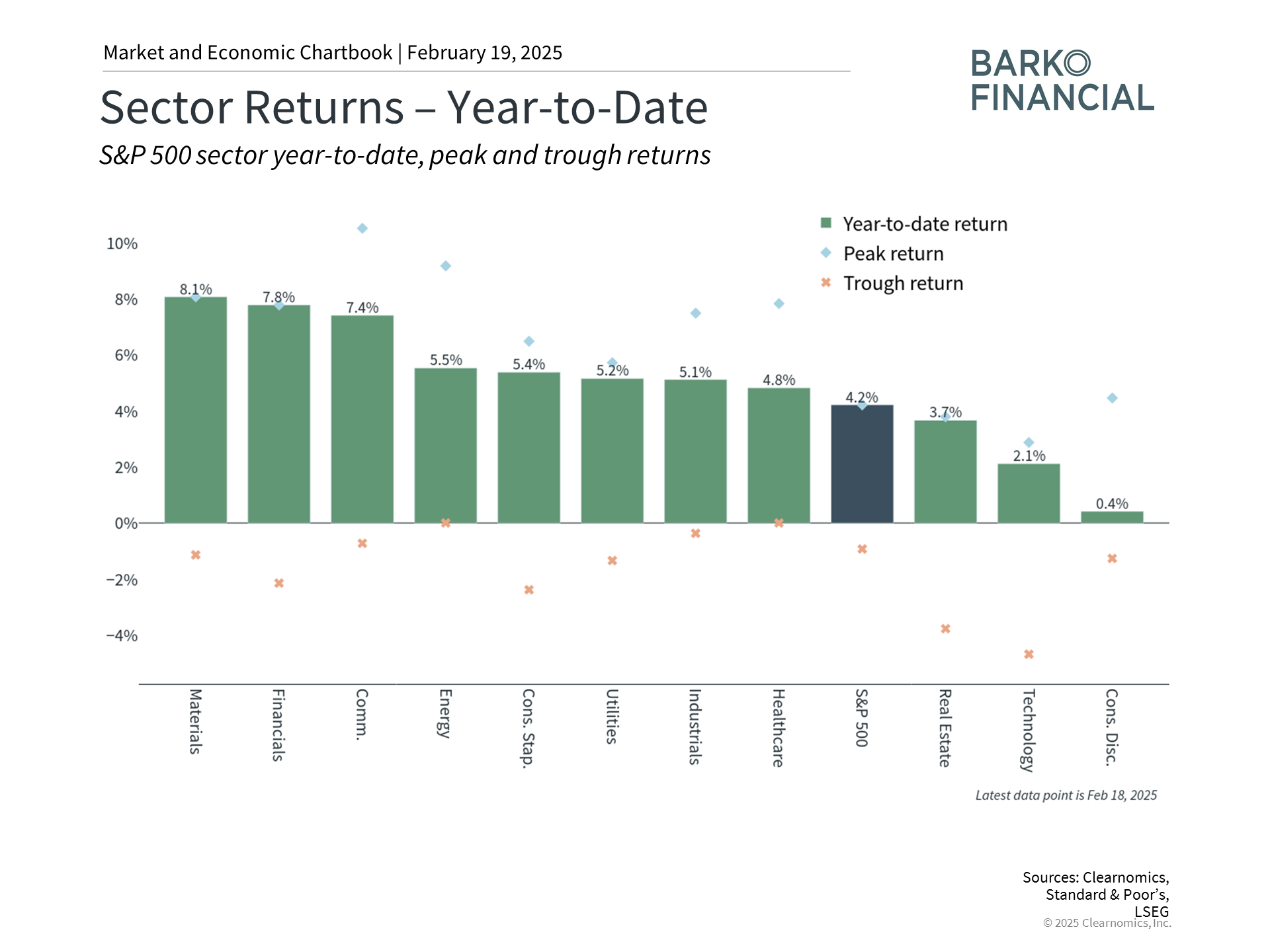
Early 2025 has seen Information Technology and Consumer Discretionary sectors underperform the broader market indices. This marks a shift from the period since late 2022, when these tech-heavy sectors, along with Communication Services, led market gains. Meanwhile, sectors such as Financials, Materials, and Consumer Staples have emerged as positive contributors.
Several factors explain this rotation, including concerns about stretched valuations, persistent interest rates, and questions surrounding corporate AI investments. The S&P 500's price-to-earnings ratio has reached 22x, nearing dot-com era peaks, while the Information Technology sector trades at 27.7x earnings. While AI infrastructure spending continues its rapid expansion, global competition in this space has intensified.
The emergence of new market leadership represents an encouraging development for those seeking broader market participation. This early-year trend suggests a more balanced market environment where gains aren't limited to a select few sectors. It also reflects investors' search for value opportunities across different market segments following strong returns over the past two and a half years.
While technology stocks can offer compelling investment potential, they typically exhibit higher volatility and economic sensitivity. The sector experienced significant drawdowns in 2022, with both the Nasdaq and S&P 500 Information Technology sector declining approximately 35% before recovering. Similar corrections occurred in 2018 and 2020.
This pattern has historical precedent, with the dot-com crash of 2000 being the most notable example. However, comparable situations have occurred throughout market history. The 1960s saw a technology boom centered on popular technology and electronics companies, which subsequently faced substantial declines during the 1970s market downturn.
Over time, technological advances - from semiconductors to information technology to large language models - create value across multiple sectors and industries. The digital transformation that began in the 1990s continues to evolve. Long-term investors should maintain balanced exposure to benefit from these broader trends rather than attempting to time sector rotations.
Market concentration remains an important consideration
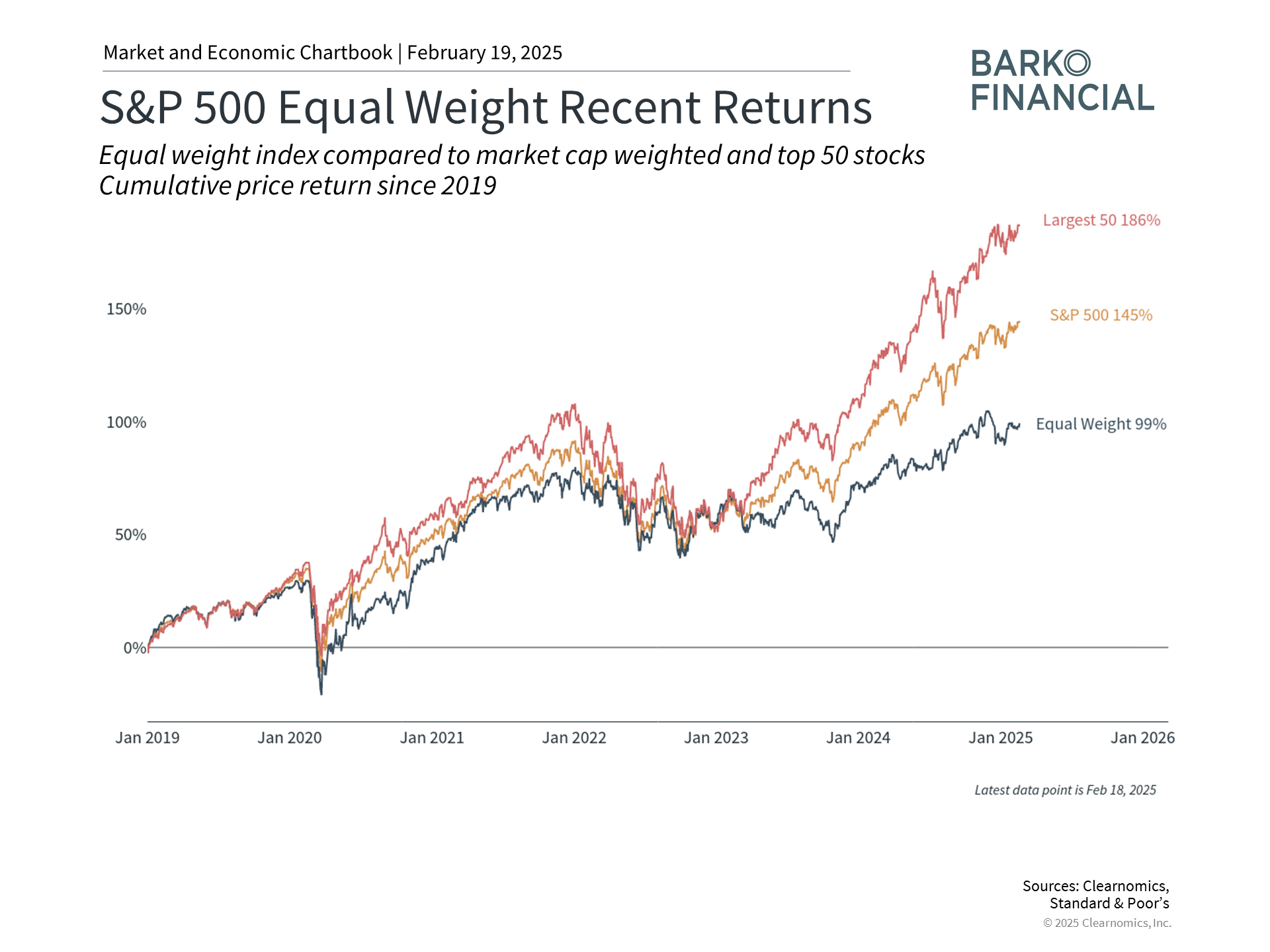 |
The evolution of market sectors has significantly impacted index composition. The largest S&P 500 constituents are now predominantly technology-related companies, collectively known as the Magnificent 7: Apple, Nvidia, Microsoft, Amazon, Alphabet, Meta, and Tesla.
The dominant influence of a small number of stocks on the broader market raises sustainability concerns among investors. This concentration risk represents potential vulnerability from excessive exposure to particular sectors, asset classes, or investment clusters. Many portfolios may have inadvertently increased their exposure to certain sectors as dominant index constituents have grown larger.
One effective way to visualize this dynamic is by comparing the market cap-weighted S&P 500 index with its equal-weighted counterpart. While the former reflects actual market composition, the latter offers exposure to a broader range of companies regardless of size.
Concentration can magnify both positive and negative returns, while diversification helps manage downside risk. In the current environment, regular portfolio monitoring and rebalancing may be necessary to maintain appropriate risk levels. Consulting with a trusted advisor who understands your financial objectives can be valuable in this process.
Multiple sectors drive long-term market performance
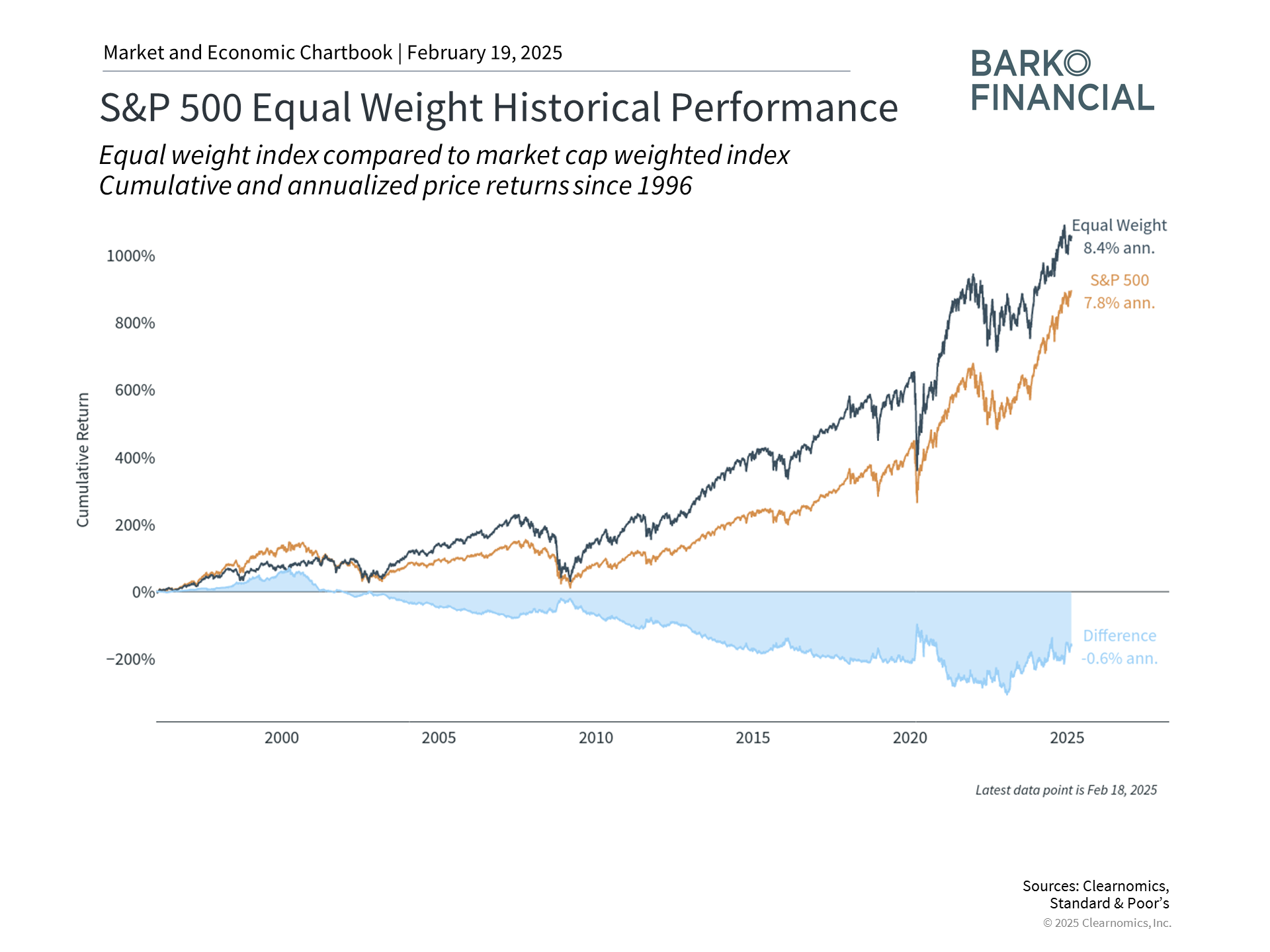 |
Despite recent tech stock dominance, historical data shows that numerous stocks have contributed to S&P 500 success over extended periods, as illustrated in the accompanying chart.
Additionally, market leadership by large companies isn't a historical constant. Throughout much of market history, the largest "blue chip" companies were often viewed as stable dividend providers rather than growth leaders.
While enthusiasm for artificial intelligence stocks persists, investors should maintain a comprehensive market perspective. If AI developments prove as transformative as anticipated, their economic impact could surpass previous technological revolutions, benefiting well-diversified investors.
The bottom line? Recent tech sector weakness shouldn't deter long-term investors from maintaining disciplined exposure across market segments.